
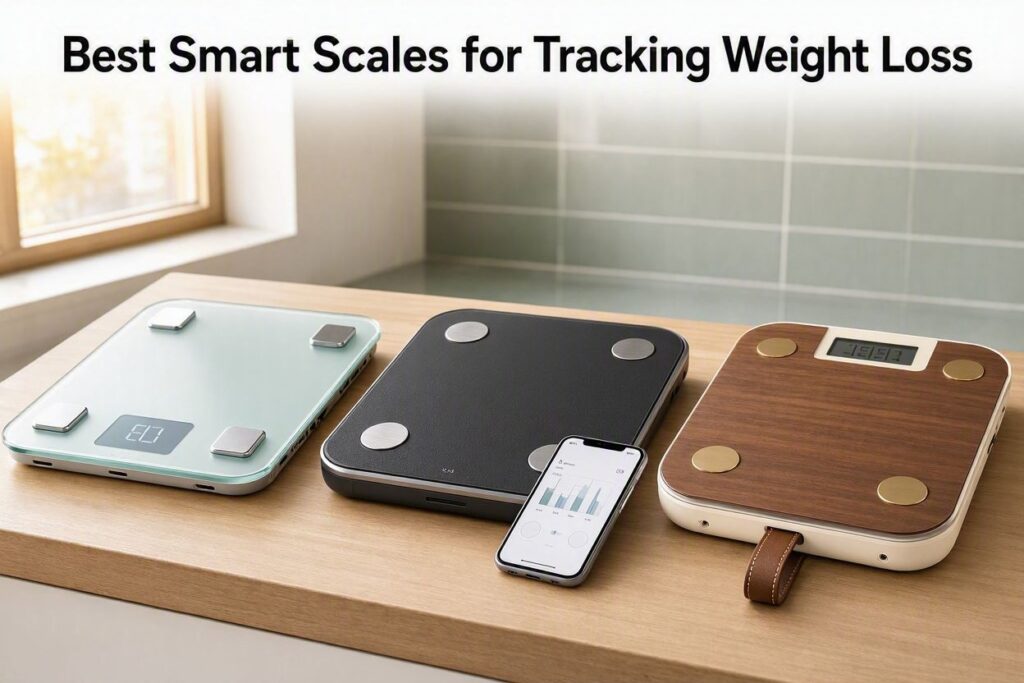
If you’ve ever stepped on a scale, seen a number that made no sense, and then just… given up checking for two weeks, you’re not alone. I’ve coached clients through weight loss for over 15 years, and the single biggest reason people quit tracking isn’t lack of willpower — it’s that they’re using a tool that doesn’t actually tell them anything useful.
A basic bathroom scale gives you one number. That number bounces around based on water retention, sodium intake, hormones, and how much you ate for dinner. It doesn’t tell you whether you’re losing fat or muscle. It doesn’t show you trends. And when it swings up two pounds overnight for no reason, it can wreck your motivation faster than a bad workout.
A good smart scale fixes that. It tracks your weight and your body composition — fat, muscle, water — automatically syncs it to an app, and shows you the trend line instead of the daily noise. That trend line is what actually keeps people consistent, and consistency is what makes weight loss work.
I tested and researched the top smart scales on the market this year with one filter: does this actually help someone lose weight and keep it off, or is it just another gadget with a scary-accurate-sounding number that means nothing? Here’s what made the cut.
Quick Comparison Table
| Scale | Best For | Metrics Tracked | Connectivity | Price |
|---|---|---|---|---|
| Withings Body Smart | Best Overall | Weight, BMI, body fat, muscle mass, water % | Wi-Fi + Bluetooth | $99 |
| Renpho ES-CS20M | Best Budget | Weight, BMI, body fat, muscle mass, 13 metrics | Bluetooth | $39 |
| Garmin Index S2 | Best for Garmin Users | Weight, BMI, body fat, muscle/bone mass | Wi-Fi + Bluetooth | $150 |
| Eufy Smart Scale P3 | Best Display | Weight, BMI, body fat, muscle mass, 16 metrics | Bluetooth | $100 |
| Wyze Scale X | Best Ultra-Budget | Weight, BMI, body fat, 12-13 metrics | Bluetooth | $29 |
| Withings Body Comp | Best Premium | Weight, body fat, visceral fat, vascular age, nerve health | Wi-Fi + Bluetooth | $200 |
In-Depth Reviews
1. Withings Body Smart — Best Overall
Withings has been making health hardware longer than nearly anyone in this category, and the Body Smart is where that experience shows. It syncs over Wi-Fi the moment you step off, so there’s no fumbling with Bluetooth pairing at 6 a.m. before coffee. The Health Mate app is genuinely the best-designed app in this space — clean graphs, an easy-to-read trend line, and integration with Apple Health, Google Fit, and most major fitness platforms.
What actually matters for weight loss: it tracks visceral fat, hydration, and a rolling weight trend that smooths out the daily noise I mentioned earlier. It also has Athlete, Pregnancy, Baby, and Eyes Closed modes, which is a nice touch if the scale is shared across a household.
Pros
- Wi-Fi sync means zero phone interaction required
- Best app in the category, easy for beginners to actually stick with
- Trend-weight feature specifically designed to reduce daily-fluctuation anxiety
- Multi-user auto-recognition (up to 8 people)
Cons
- Some advanced metrics (Health Improvement Score) are locked behind a subscription
- No on-scale display beyond your basic weight — everything else lives in the app
Pricing: $99, no subscription required for core tracking features.
Who it’s best for: Anyone who wants a “set it and forget it” experience with minimal fuss and the best app experience available. This is my default recommendation for someone starting a weight loss journey who wants data without becoming a data analyst.
2. Renpho ES-CS20M — Best Budget Option
Renpho has quietly become the value leader in this category, and the ES-CS20M proves why. At $39, it tracks 13 body composition metrics and syncs with essentially every platform you’d want — Apple Health, Google Fit, Fitbit, Samsung Health, and Garmin Connect. Weight accuracy is excellent, with tight repeatability between weigh-ins, which is the metric that actually matters most for trend tracking.
Body fat percentage readings run a bit higher than premium scales like Withings, but here’s the thing: for weight loss tracking, absolute accuracy on body fat matters far less than consistency. If your scale is always reading 2% high, your trend line is still accurate — you’re just calibrating against yourself, not a lab.
Pros
- Exceptional value — 13 metrics for under $40
- Syncs with nearly every major fitness app
- Reliable weight repeatability
Cons
- Bluetooth only, so your phone needs to be nearby at weigh-in
- Body fat estimates run higher than premium scales (consistent, but not lab-accurate)
Pricing: $39, one-time cost, no subscription.
Who it’s best for: Budget-conscious beginners who want real body composition data without paying for the premium app ecosystem. This is the scale I recommend most often to clients just starting out.
3. Garmin Index S2 — Best for Garmin Users
If you already wear a Garmin watch, the Index S2 closes the loop. Your weight, body fat, and muscle mass data flow directly into Garmin Connect alongside your workouts, sleep, and heart rate data, so you get one unified dashboard instead of juggling two apps. Both Wi-Fi and Bluetooth are supported, and it’s built to handle a household with multiple users.
The scale itself is accurate and consistent, though you’re paying a premium specifically for the ecosystem integration rather than for additional metrics compared to scales in the same price range.
Pros
- Seamless integration with Garmin Connect and existing Garmin devices
- Wi-Fi and Bluetooth both supported
- Reliable, consistent readings
Cons
- Premium price mostly buys ecosystem integration, not extra metrics
- Less useful if you don’t already use Garmin devices
Pricing: $150.
Who it’s best for: Existing Garmin watch or fitness tracker owners who want their weight data living in the same app as their training data.
4. Eufy Smart Scale P3 — Best On-Scale Display
Most smart scales make you pull out your phone to see anything beyond your basic weight. The P3 flips that: it has a large, clear 3.5-inch LCD that shows your weight, body fat, muscle mass, and BMI right on the scale the instant you step off. For people who don’t want to open an app every morning, that’s a meaningful difference.
It tracks 16 body metrics total and supports 16 users with auto-recognition, though if two people in the household have similar weights, it can occasionally mix up whose data is whose.
Pros
- Largest, clearest on-scale display in the category — no phone required to see your stats
- Tracks a wide range of metrics (16)
- Supports large households
Cons
- Auto-recognition can misassign data between users of similar weight
- Default weigh-in reminders can feel like nagging if you’re not careful with settings
Pricing: $100.
Who it’s best for: People who want their stats immediately, without unlocking a phone every morning — especially useful for older adults or anyone who prefers simplicity over app-diving.
5. Wyze Scale X — Best Ultra-Budget Option
At $29, this is the cheapest smart scale actually worth buying. It tracks 12–13 body metrics, connects to Apple Health and Google Fit, and gives you consistent weight readings weigh-in after weigh-in. It also has genuinely useful specialty modes — Baby, Pet, Luggage, and Pregnancy mode, which disables the electrical current used for body composition readings for safety.
Body composition accuracy is the weakest of any scale on this list, but if your main goal is simply “log my weight daily and see the trend,” it does the job without asking you to spend more than a takeout order.
Pros
- Lowest price point that’s still genuinely reliable
- Good app integration for the price
- Thoughtful specialty modes (pregnancy-safe setting is a nice detail)
Cons
- Least accurate body composition readings in this lineup
- Bluetooth only
Pricing: $29.
Who it’s best for: Anyone who mainly wants consistent weight tracking and app syncing without spending much, or as a low-risk way to test whether you’ll actually use a smart scale before upgrading.
6. Withings Body Comp — Best Premium Pick
This is the scale for someone who wants to go deep. Beyond the standard metrics, the Body Comp adds visceral fat index and even nerve health readings via electrodermal activity sensors — genuinely unusual for a bathroom scale. It’s built for people who are serious about long-term health monitoring, not just a number on the scale, and it pairs with the same excellent Health Mate app as the Body Smart.
To be direct: most people trying to lose 20-30 pounds do not need this level of detail, and some of the advanced metrics add complexity without adding motivation. But if you’re managing a broader health picture alongside weight loss, it’s the most comprehensive option available.
Pros
- Most comprehensive metric set of any scale on this list
- Excellent app and Wi-Fi sync
- Genuinely useful for long-term health tracking beyond just weight
Cons
- Expensive relative to what most weight-loss-focused users actually need
- Extra metrics can lead to overanalyzing rather than staying motivated
Pricing: $200.
Who it’s best for: People with broader health goals — not just weight loss — who want lab-adjacent data at home and are willing to pay for it.
Frequently Asked Questions
Are smart scale body fat readings actually accurate? Not compared to a lab-grade DEXA scan — most smart scales use bioelectrical impedance analysis (BIA), which can be off from clinical measurements. But for tracking your own trend over time, they’re consistent enough to be useful. The number matters less than the direction it’s moving.
How often should I weigh myself for weight loss? Daily weigh-ins, viewed as a rolling weekly average rather than a single number, tend to work best for building the habit and staying motivated. If daily weighing creates anxiety or an unhealthy relationship with the number, weighing 2-3 times a week is a healthier alternative.
Do I need Wi-Fi, or is Bluetooth enough? Bluetooth works fine if your phone is nearby when you weigh in. Wi-Fi scales sync automatically without your phone present, which is more convenient if you want a completely hands-off experience.
Will a smart scale work with my fitness tracker or app? Most major scales sync with Apple Health, Google Fit, Fitbit, and Samsung Health. If you use a specific ecosystem like Garmin Connect, a Garmin-branded scale gives you the tightest integration.
Is it worth paying more for a premium scale? Only if you’ll actually use the extra features. The jump from a basic scale to any smart scale is the biggest behavior-change leap. Beyond that, you’re mostly paying for a better app and a couple of extra metrics most people won’t act on.
Final Verdict
For most people trying to lose weight in 2026, the Withings Body Smart is the pick — the trend-weight feature and the smooth, no-hassle Wi-Fi sync solve the exact problem that makes people quit tracking in the first place. If you’re just starting out and want to keep costs low, the Renpho ES-CS20M gives you real body composition data for under $40, and it’s the one I hand to clients most often.
Whichever scale you choose, the honest truth after 15 years of doing this: the best smart scale is the one you’ll actually step on every day. Buy the one that fits your budget and your habits, not the one with the most impressive spec sheet.