
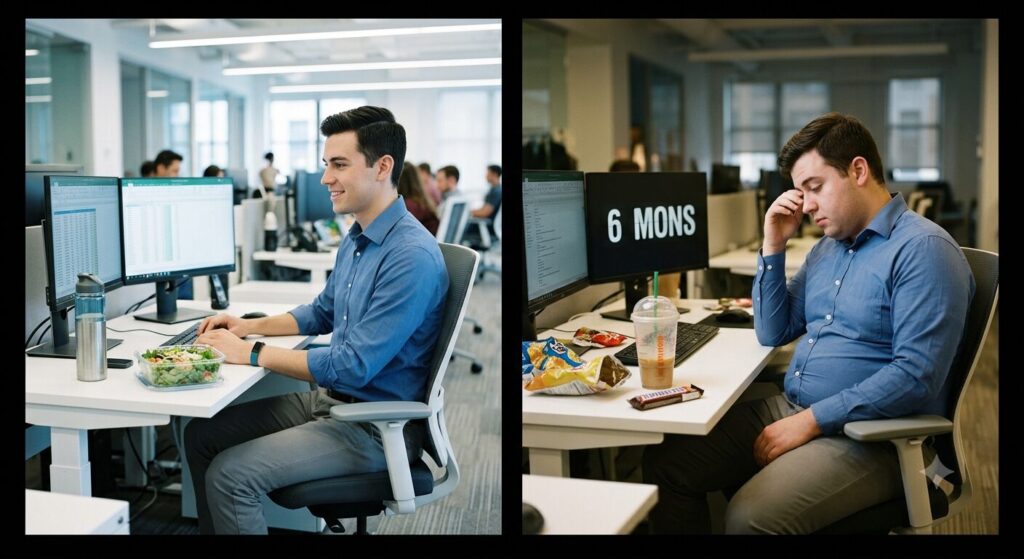
You don’t have to quit your desk job to lose weight — you just have to outsmart it.
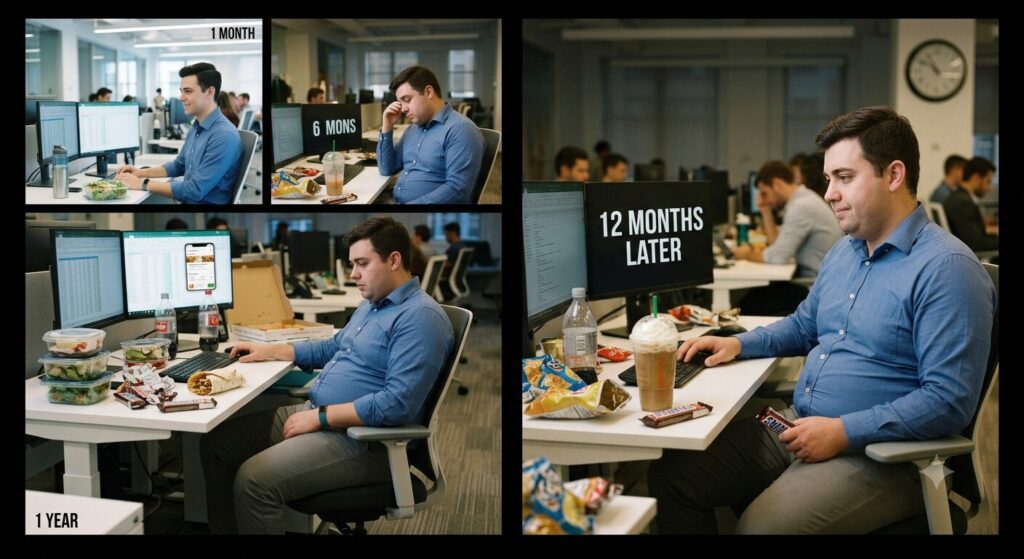
Let’s be honest. You sit down at 8 a.m., blink, and somehow it’s 5 p.m. and the only steps you’ve logged are the trip to the coffee machine and the bathroom. The weight crept on slowly — a pound here, two pounds there — and now you’re wondering how you got here without ever feeling like you were doing anything wrong.
The truth is, weight loss for office workers is a real challenge, but it’s absolutely solvable. You don’t need a gym membership or a meal prep obsession. What you need is a smarter system that works inside the hours you already have.
This guide breaks down exactly how to lose weight at a desk job — using simple strategies you can start today, even if you’ve tried (and quit) before.
Why Desk Jobs Cause Fat Gain
Before we talk about solutions, it helps to understand the problem. Office work creates a perfect storm of conditions that quietly drive fat gain over time.
The movement problem. The average office worker takes fewer than 3,000 steps a day. For context, most health guidelines suggest 7,000–10,000. That gap represents hundreds of calories a day that your body isn’t burning — calories that get stored instead.
The snacking trap. Office environments are loaded with food triggers: the candy dish on a coworker’s desk, the donuts someone brought on Friday, the vending machine humming right outside the break room. Stress and boredom — both common at desk jobs — are two of the biggest drivers of mindless eating.
The sitting-metabolism connection. Extended sitting has been shown to reduce the activity of lipoprotein lipase, an enzyme responsible for breaking down fat. In plain English: the longer you sit without moving, the slower your body processes the fuel you feed it.
The mental fog-hunger loop. Staring at a screen for hours strains your brain. Your body’s response to cognitive fatigue? Reach for sugar. This explains that 2:30 p.m. candy craving that hits like clockwork.
The good news: none of these are permanent. They’re patterns — and patterns can be changed.
The “Movement Snacks” Strategy
If you can’t get to the gym before or after work, the next best thing is distributing movement throughout your day in small doses. This is called movement snacking — and research backs it up as an effective strategy for improving metabolic health and supporting fat loss.
A movement snack is any 2–5 minute burst of physical activity broken up across your workday. It doesn’t need to be intense. It just needs to be consistent.
How to build movement snacks into your day:
Set a recurring timer on your phone or computer for every 45–60 minutes. When it goes off, get up and do one of the following:
- Walk a lap around your office or building
- Do 10–15 bodyweight squats beside your chair
- Walk to a restroom on a different floor
- Do 20 calf raises while standing at your desk
- Refill your water bottle (this doubles as a hydration habit)
Why this works for desk job fat loss: Even light movement spikes your heart rate slightly, re-engages your muscles, and interrupts the metabolic slowdown caused by prolonged sitting. Over the course of a full workday, these micro-sessions add up to meaningful calorie expenditure — often 150–300 additional calories burned without a single gym visit.
Start with just 3 movement breaks per day and build from there. Consistency over intensity is the rule here.
Smart Office Eating Habits
You cannot out-exercise a bad office diet. The vending machine, the birthday cake in the conference room, and the fast food run at lunch will undo your movement efforts faster than you think. Here’s how to build eating habits that support your weight loss goals without making your coworkers hate you.
Pack your lunch (non-negotiable). Eating out at work almost guarantees excess sodium, hidden calories, and portion sizes designed to make you feel full in a way that leads to afternoon energy crashes. Packing your own food puts you in control. Aim for meals with lean protein, fiber-rich vegetables, and a small amount of complex carbs. Think grilled chicken and roasted vegetables, not sad sad desk salads with croutons and sugary dressing.
Pre-portion your snacks. Don’t bring a whole bag of trail mix or a sleeve of crackers to your desk. Portion your snacks at home into individual servings so you’re not mindlessly eating while staring at a spreadsheet. A good office snack combination: protein + fat + fiber. Examples include a hard-boiled egg with an apple, Greek yogurt with almonds, or string cheese with raw veggies.
Avoid the vending machine entirely. The easiest way to stop eating vending machine garbage is to never be in a position where you need it. Keep a desk drawer stocked with emergency snacks — protein bars, nuts, dried fruit, or jerky — so you’re never starving at 3 p.m. with a dollar in your hand.
Break the coffee-sugar cycle. Many office workers unknowingly consume 300–500 calories a day through flavored lattes, sweetened coffee drinks, and sodas. Switch to black coffee, plain tea, or water with flavor drops. It’s uncomfortable for about a week. Then you stop craving the sugar.
The “eat before you’re desperate” rule. Waiting until you’re starving at your desk is a guaranteed setup for a bad decision. Eat regularly — every 3–4 hours — to keep hunger from spiking to desperation level.
Daily Desk Routine for Fat Loss
Weight loss for office workers is about building a daily rhythm that creates a small, consistent calorie deficit. Here’s what a realistic office day looks like when it’s optimized for fat loss:
Morning (before you sit down):
- Drink 16 oz of water before coffee
- Eat a protein-forward breakfast (eggs, Greek yogurt, cottage cheese, or a protein shake) — this reduces midday hunger significantly
- Park farther away or get off public transit one stop early to log extra steps before work begins
During the workday:
- Set a movement alarm every 45–60 minutes
- Aim for a minimum of 250 steps per hour (a short walk achieves this easily)
- Keep a 32 oz water bottle on your desk and finish it by noon, then refill
- Eat your packed lunch away from your desk if possible — eating mindfully reduces total calorie intake
Afternoon (the danger zone):
- Have your pre-portioned snack ready at 2:30–3:00 p.m. before the craving hits
- Do a 5-minute walk outside if possible — natural light and movement are the best afternoon energy reset available
- Avoid the vending machine and communal office candy
End of day:
- Log your steps before you leave. Your goal: 6,000–8,000 steps as a minimum. 10,000 if you can swing it.
- Walk to your car or transit stop via the long route
Weekly step goal framework:
| Week | Daily Step Goal | Notes |
|---|---|---|
| 1–2 | 5,000 steps | Build the habit |
| 3–4 | 6,500 steps | Add one extra walk |
| 5–6 | 8,000 steps | Movement snacks are consistent |
| 7+ | 10,000 steps | Sustainable daily target |
This gradual build prevents burnout and makes the habit stick.
Simple At-Desk Exercises
You don’t need a standing desk or a treadmill desk to stay active at the office. These exercises can be done quietly, at your desk or nearby, with no equipment and no gym clothes required.
While seated:
Seated leg raises — Sit up straight, extend one leg until it’s parallel to the floor, hold for 3 seconds, lower slowly. Do 10–15 reps per leg. Works your core and hip flexors.
Desk chair twists — Sitting upright, rotate your torso to the right and hold the back of your chair for 2 seconds. Rotate left. Do 10 per side. Relieves tension and activates your obliques.
Calf raises (seated) — While seated, raise both heels off the floor and hold for 2–3 seconds. Repeat 20 times. Helps circulation and works the calves.
While standing near your desk:
Wall sits — Find a wall, lower into a seated position with thighs parallel to the floor, hold for 30–60 seconds. Intense quad and glute activation. Do this during a phone call.
Standing calf raises — Hands on the desk for balance. Rise onto the balls of your feet and lower slowly. 20 reps. Burns surprisingly fast.
Chair-assisted squats — Use your chair as a squat target. Stand in front of it, lower until you almost touch the seat, then drive back up. 10–15 reps. Full lower body engagement.
Stretches to reduce stiffness and tension:
Neck rolls — Drop your chin to your chest and slowly roll your head side to side. 5 per direction.
Hip flexor stretch — Stand, step one foot forward into a gentle lunge, and drop your back knee slightly. Hold 20–30 seconds per side. Critical for anyone sitting all day.
Shoulder cross stretch — Bring one arm across your chest and hold with the opposite hand. Hold 20 seconds per side.
Doing one round of these exercises during each movement break covers both your cardio-ish movement and your flexibility work simultaneously.
Your Next Step: Start Tracking Today
Here’s the thing about losing weight at a desk job — it’s not about massive overhauls. It’s about stacking small, consistent wins every single day until the weight starts moving.
The single most effective first step you can take right now? Start tracking your daily steps.
Download a free step tracker app (most smartphones have one built in), check your baseline this week, and aim to beat it by 500 steps next week. That’s it. That’s the whole first assignment.
From there, layer in one new habit at a time — pack your lunch, set your movement alarm, drink more water, add a stretch break. Within 30 days you’ll have a completely different daily rhythm. Within 60–90 days, the scale will start confirming what your habits already know.
You don’t have to leave your desk job to lose weight. You just have to stop letting it run your life on autopilot.
Start with your steps. Everything else follows.
Click Here For More Articles.
Looking for more practical weight loss tips for busy people? Browse our full health and fitness archive for simple strategies that fit real life.