
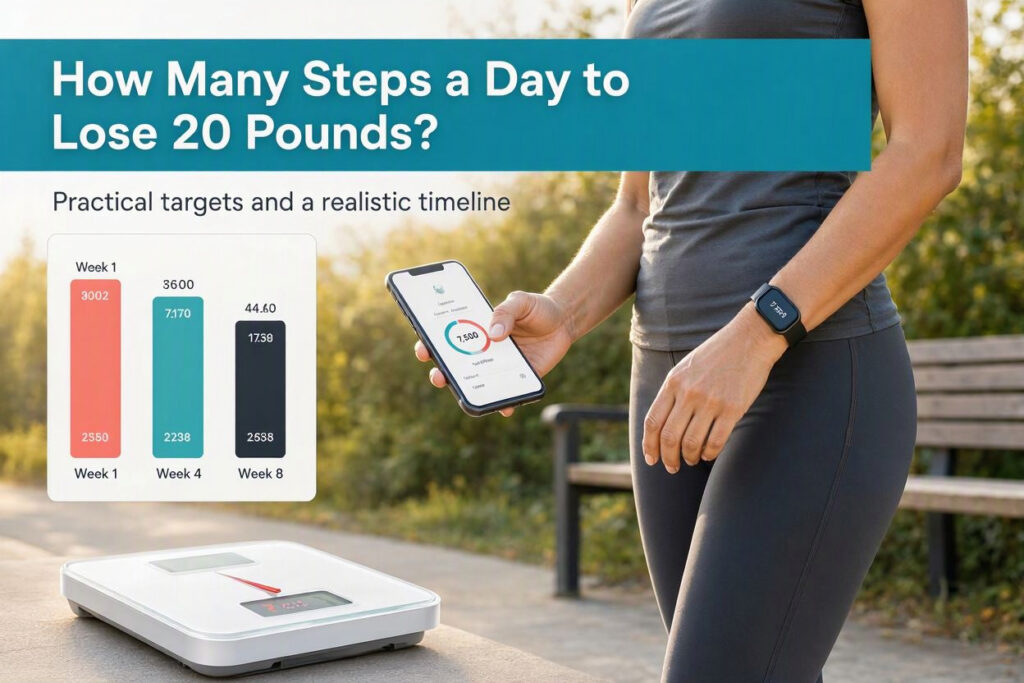
If you’re trying to figure out how many steps a day to lose 20 pounds, the short answer is: most people need to walk somewhere between 10,000 and 15,000 steps a day, paired with a consistent calorie deficit, to lose 20 pounds in a realistic and sustainable timeframe. There’s no single magic number that works for everyone — your current weight, walking pace, diet, and activity level all change the math.
This guide breaks down exactly how steps translate into calories burned, how many steps you actually need based on your body weight and timeline, and how to build a walking plan that gets you to your goal without burning out.
Key Takeaways
- A pound of body fat is roughly 3,500 calories, so losing 20 pounds requires a total deficit of about 70,000 calories over time.
- Most adults burn 300–500 calories walking 10,000 steps, depending on weight and pace.
- To lose 20 pounds in 4–5 months, most people need 12,000–15,000 steps a day combined with modest diet changes — walking alone, without any dietary adjustment, would take considerably longer for most people.
- Heavier individuals burn more calories per step, so your personal number may be lower or higher than the averages below.
- Consistency beats intensity — a sustainable daily step count you can maintain for months matters more than a perfect number you can only hit for a week.

How Steps Convert to Calories Burned
Before you can figure out your target step count, it helps to understand the actual math behind it.
Calories Burned Per Step
The number of calories you burn per step depends heavily on body weight, pace, and terrain. On flat ground at a moderate pace, most people burn somewhere in the range of 0.04–0.06 calories per step. That works out to roughly:
- 120–140 lb person: ~350–400 calories per 10,000 steps
- 150–170 lb person: ~400–450 calories per 10,000 steps
- 180–200 lb person: ~450–525 calories per 10,000 steps
- 220+ lb person: ~525–600+ calories per 10,000 steps
Heavier bodies require more energy to move the same distance, so if you’re carrying more weight to lose, you’ll typically burn more calories per step than someone lighter — which works in your favor early in a weight-loss journey.
Steps Per Mile
Step count also depends on stride length. A person of average height covers about 2,000–2,500 steps per mile, meaning 10,000 steps is roughly 4–5 miles of walking.
How Many Steps to Lose 20 Pounds: The Real Math
To lose one pound of fat, you need a cumulative deficit of about 3,500 calories. Losing 20 pounds means creating a total deficit of approximately 70,000 calories.
Here’s how that breaks down across different daily step goals, assuming walking is your primary added activity and you’re not otherwise changing your diet:
| Daily Steps | Est. Calories Burned/Day | Days to Burn 70,000 Cal (Walking Only) | Approx. Timeline |
|---|---|---|---|
| 7,000 steps | ~275–325 cal | ~215–255 days | 7–8.5 months |
| 10,000 steps | ~350–450 cal | ~155–200 days | 5–6.5 months |
| 12,500 steps | ~450–550 cal | ~125–155 days | 4–5 months |
| 15,000 steps | ~525–650 cal | ~110–135 days | 3.5–4.5 months |
| 20,000 steps | ~700–850 cal | ~85–100 days | 3–3.5 months |
Important: These numbers assume walking is your only source of deficit. In practice, almost nobody loses 20 pounds from walking alone — pairing your step count with a modest 300–500 calorie/day reduction in food intake cuts these timelines roughly in half and is the approach most doctors and dietitians recommend for sustainable results.

A More Realistic Combined Approach
If you combine a daily walking habit with a moderate calorie deficit from diet, the numbers look far more achievable:
| Daily Steps | Diet Deficit/Day | Total Deficit/Day | Time to Lose 20 lbs |
|---|---|---|---|
| 8,000 steps | 300 cal | ~600–700 cal | ~100–115 days (~3.5 months) |
| 10,000 steps | 300 cal | ~650–750 cal | ~95–105 days (~3.2 months) |
| 10,000 steps | 500 cal | ~850–950 cal | ~75–85 days (~2.7 months) |
| 12,500 steps | 500 cal | ~950–1,050 cal | ~70–75 days (~2.4 months) |
Losing weight faster than 1–2 pounds per week generally isn’t recommended, so even if your calorie math allows for a faster pace, gradually working up to your step goal and pairing it with sustainable eating habits is the safer route.
Recommended Step Targets by Goal
Not everyone needs to aim for the same number. Where you start matters.
If You’re Currently Sedentary (Under 5,000 Steps/Day)
Jumping straight to 15,000 steps is a recipe for burnout or injury. Instead:
- Week 1–2: Aim for 6,000–7,000 steps daily
- Week 3–4: Increase to 8,000–9,000 steps
- Week 5+: Build toward 10,000–12,000 steps as your baseline
Research on previously inactive adults shows meaningful health improvements and modest weight loss can begin around 7,000 steps a day, even before reaching the commonly cited 10,000-step benchmark.
If You’re Moderately Active (5,000–8,000 Steps/Day)
You likely have room to add 3,000–5,000 more steps without major lifestyle disruption. A short 20–30 minute walk in the morning and another after dinner is often enough to close the gap.
If You’re Already Active (8,000–10,000+ Steps/Day)
If you’re already hitting 10,000 steps and the scale isn’t moving, walking more isn’t necessarily the answer. At this point, it’s usually more effective to:
- Add strength training to build muscle and boost resting metabolism
- Increase walking intensity (incline, pace, or added weight) rather than just volume
- Reassess your calorie intake, since diet is often the bigger lever once activity is already high
Pro Tips to Hit Your Step Goal Without It Feeling Like a Chore
1. Break it into 3–4 mini walks. A 10,000-step goal feels more manageable as four 25-minute walks than one long slog. Try one after each meal — it also helps regulate post-meal blood sugar.
2. Walk before caffeine, not after. A short walk first thing in the morning (even 10 minutes) tends to stick as a habit better than one you have to plan around your day.
3. Use incline or stairs to add intensity without adding time. Walking uphill or on an incline treadmill setting burns significantly more calories per step than flat ground, so you can hit your calorie target with fewer total steps.
4. Pair walks with something you already do. Phone calls, podcasts, or audiobooks turn “exercise time” into time you were going to spend sitting anyway.
5. Track trend, not daily perfection. Aim for a weekly average rather than hitting your exact number every single day. Two lighter days followed by a longer weekend walk still gets you there.
6. Add light hand or ankle weights sparingly. This can modestly increase calorie burn, but isn’t necessary — consistency in step count matters far more than gimmicks.
7. Don’t neglect protein. Higher protein intake helps preserve muscle mass during a calorie deficit, which keeps your metabolism from slowing down as much as weight comes off.
8. Get a full night’s sleep. Poor sleep is linked to increased hunger hormones and reduced motivation to move, making it harder to hit your step goal consistently.
Walking 10K Steps Weight Loss Results: 7 Powerful Transformations You Can Expect
Common Mistakes That Slow Down Progress
- Only tracking steps, not calories. Walking creates the deficit; overeating can erase it. A 30-minute walk can be undone by a single extra snack.
- Going too hard too fast. Jumping from 3,000 to 15,000 steps overnight often leads to soreness, blisters, or quitting within two weeks.
- Ignoring non-walking activity. Standing, light housework, and errands all add to your daily total — wearing a tracker all day (not just during “workouts”) gives a more accurate picture.
- Expecting linear weight loss. Water retention, hormones, and muscle gain from increased activity can mask fat loss on the scale for days at a time. Trends over 2–3 weeks matter more than daily fluctuations.
FAQs
How many steps a day to lose 20 pounds in 3 months? To lose 20 pounds in roughly 3 months, most people need to combine 12,000–15,000 steps a day with a moderate calorie deficit from diet (around 400–500 calories daily). Walking alone rarely closes a 70,000-calorie gap that quickly for most body weights.
Is 10,000 steps a day enough to lose 20 pounds? 10,000 steps a day can support meaningful weight loss, but on its own it typically burns 300–450 calories daily — not usually enough to lose 20 pounds quickly without also adjusting your diet. Combined with a modest calorie deficit, 10,000 steps is a solid, sustainable target for most adults.
How many steps burn 1 pound of fat? Since a pound of fat is roughly 3,500 calories, and 10,000 steps burns approximately 300–450 calories depending on body weight, it generally takes 8–12 days of walking 10,000 steps to burn one pound through walking alone.
Do I need to walk fast or just hit the step count? Both matter, but total volume tends to matter more for calorie burn than pace alone. That said, brisk walking (a pace where talking is possible but singing is not) burns more calories per step and offers greater cardiovascular benefits than a slow stroll.
Can I lose 20 pounds by walking without changing my diet? It’s possible but slow for most people — often 6 months or longer at 10,000–12,000 steps a day. Pairing your walking routine with even a small, sustainable reduction in daily calories (300–500 calories) significantly shortens the timeline.
What’s a realistic weekly weight loss rate while walking? Most health guidelines recommend 1–2 pounds per week as a safe, sustainable rate. At that pace, losing 20 pounds takes roughly 10–20 weeks, depending on your starting point and consistency.
Does walking after meals help more than walking at other times? A short 10–15 minute walk after meals can help moderate blood sugar spikes and may support fat loss slightly more efficiently than the same walk taken at a random time of day, though total daily step count still matters most overall.
Final Verdict
There’s no single universal number for how many steps a day it takes to lose 20 pounds — it depends on your current weight, activity level, and whether you’re also adjusting your diet. As a practical target, 10,000–12,500 steps a day combined with a modest calorie deficit gets most people to a 20-pound loss in roughly 3–5 months at a safe, sustainable pace. Start where you are, build up gradually if you’re currently inactive, and focus on a weekly average rather than perfection — consistency over months is what actually moves the scale.
This article is for general informational purposes and isn’t a substitute for personalized medical or nutritional advice. Consult a healthcare provider before starting a new exercise or weight-loss program, especially if you have existing health conditions.